The taranto, a film and a tablao
Where the name Tarantos comes from
The name Los Tarantos joins a flamenco song from the Almería mines, Carmen Amaya's last film and a Barcelona tablao that opened in 1963. The story, sourced.
Reserve your Los Tarantos night ↗A song from the Almería mines
The taranto is a flamenco style from the province of Almería in Andalusia, in the mining country. It is counted among the songs of the mines, a group that also includes the fandango and the taranta. People from Almería were traditionally called Tarantos. Early singers credited with it include Pedro el Morato, born in the 1830s, and El Cabogatero, long before anyone thought of putting the word on a Barcelona doorway. Wikipedia notes that sources sometimes use taranto and taranta interchangeably, so the terms are not fully settled.
How a loose song became a dance
The taranto descends from the taranta, a free song with no regular beat. What sets the taranto apart is that it keeps a slight compás, a rhythmic frame, and that makes it possible to dance. Wikipedia credits Carmen Amaya with popularising the taranto dance around the 1940s. A song of the mines therefore became a stage dance, and the word began to travel with her. It is usually described as having a regular two-beat metre, which is why it can carry a dance.
Carmen Amaya
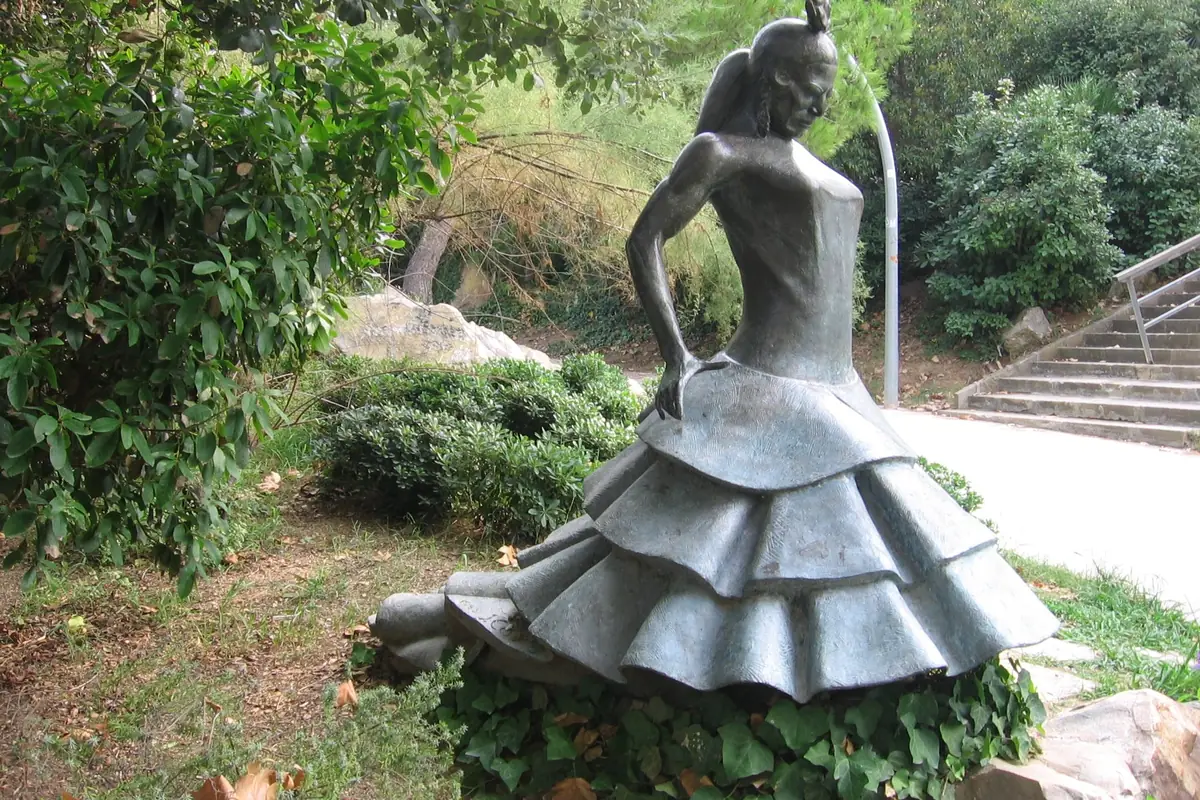
Carmen Amaya was a Romani dancer and singer, born in 1918 in the Somorrostro quarter of Barcelona, though some sources give 1913. She began performing as a child with her father, a guitarist, debuted in Barcelona and later performed in Paris and Latin America. She toured the United States from 1941, appearing at Carnegie Hall, and returned to Spain in 1947. She is described as the first woman to master footwork that had been reserved for the best male dancers. She died on 19 November 1963 in Begur, aged 45, the same year the film was released. Her memory is marked on Montjuïc, where a monument was raised in 1966, and a bronze dancer by Josep Cañas stands in the Jardins de Joan Brossa.
The film
Los Tarantos is a 1963 film directed by Francisco Rovira Beleta, based on Alfredo Mañas's play La historia de los Tarantos and inspired by Romeo and Juliet. It follows two Romani families in Barcelona whose children fall in love despite a feud between their parents. Amaya plays Rafael's mother, Angustias, in what was her last film, and the cast includes the flamenco musician Peret as a guitarist. The film was nominated for Best Foreign Language Film at the 36th Academy Awards. The score credits four composers, among them Andrés Batista, Emilio Pujol and José Solá.
The tablao opens
Los Tarantos opened in 1963 on Plaça Reial, the same year as the film, and it is described as the oldest tablao in Barcelona. Wikipedia ties the name to both the taranto and the film. Early performers named there include the dancers Antonio Gades and La Tolea, the guitarists Andrés Batista and Pepe Pubill, and the singers Fosforito and Pepe Cortés. In the 1970s, Maruja Garrido was the main artist on the stage. Visitors to the room are said to have included Tom Jones, Paul McCartney and Muhammad Ali, then known as Cassius Clay.
A shorter show from the 1990s
In the 1990s the Mas i Mas group took over the venue's management, and after a modernisation the show was shortened to about 40 minutes. Performers in that period included Miguel Poveda, Montse Cortés and José el Francés. The format has stayed close to that length since, which is why a visit today fits easily into an evening instead of taking over the whole of it. That change came well before UNESCO's 2010 listing of flamenco, which the venue's history page mentions.
What the name means in the room
Today the venue says its shows rest on improvisation and mix big names in flamenco with up-and-coming artists from the local and national scenes. You will not necessarily hear a taranto on a given night, because the styles change with the artists. But when one comes up, you now know where it comes from, and why a Barcelona room carries the name. The guide to flamenco for first-timers explains what else to listen for.
Read next: Flamenco for first-timers
Sources